
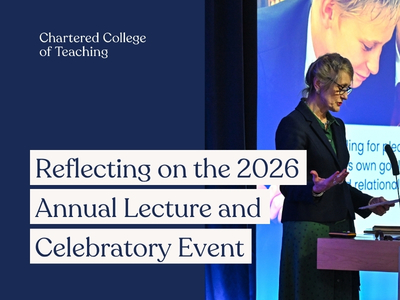
On Saturday 21st March 2026, the British Library in London played host to our Annual Lecture and Celebratory Event, bringing together Fellows, members, Chartered Teacher graduands and their families, council members and staff.
Following a welcome speech from Dame Alison Peacock, the Annual Lecture was delivered by Professor Teresa Cremin CBE on the theme of Reading for Pleasure. Professor Cremin is Professor of Education at The Open University, where she leads the Reading for Pleasure Research and Practice Coalition, a team of leading international academics and education professionals who work with schools, MATs, teachers, organisations and universities to leverage reading for pleasure as a tool for social justice.
The research-packed lecture addressed our responsibility to understand why reading for pleasure matters and the challenges involved, how being an engaged reader can drive long-term outcomes academically, socially and emotionally, and the rigour needed to nurture Reading for Pleasure pedagogy in classrooms. As Professor Cremin put it:
“This is very different from instruction about reading. This is not about assessment. It’s not about levels. It’s not about tasks. It’s about building young readers who want to read and who do so regularly. It’s about choice and habit, and it’s about reading in their time as well as in our school-framed time.”
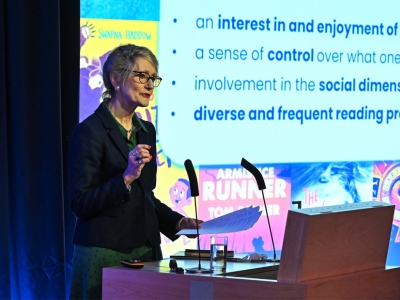
Professor Cremin also examined what motivates young readers: the intrinsic, extrinsic, and social motivations, and how school book clubs can help to nurture these motivations and embed a reading culture in schools where children are engaged with texts not only because they find them interesting, but because they want to talk about them with their peers. The social dimension of reading resonated strongly with those in attendance. Anna Szpakowska FCCT reflected:
“The notion of the social motivation to read chimed strongly with me and I think this is a particularly important aspect for teenagers when we know that peer influence plays an enormous part in shaping their emerging adult identities.”
Gerlinde Achenbach FCCT echoed this sentiment:
“I particularly appreciated the focus on socio-emotional and relational benefits supporting a sense of belonging.”
Professor Teresa Cremin also analysed what makes an impactful library experience, reflecting on one assistant headteacher’s approach to creating a library space in her primary school, owned, used and shaped by the children themselves, rather than made by teachers for children. This child-led approach was extended to the practical details of how such spaces are curated: offering fewer title choices but multiple copies of the same book encourages shared reading experiences, while in classroom mini libraries, only books the teacher has personally read are included, enabling them to encourage genuine dialogue and engage with pupils around the texts.

Encouraging reader engagement was central to the lecture, and Professor Cremin brought this to life by reading aloud from David Almond’s The Dam. This spoke to a broader point about the importance of reading aloud in the classroom: it provides opportunities for children to experience stories together, access more challenging texts than they might tackle independently, and develop their sense of what reading can feel like as a pleasurable, shared activity. As Professor Cremin noted:
“Fiction has different demands upon us. It requires deep attention, sophisticated inferencing, following perspectives, engaging in critical thinking. It develops imagination and empathy as well as social cognitive development.”
The lecture also provided correlational evidence to support the case that reading for pleasure is associated with increased reading comprehension and attainment, wider general knowledge and vocabulary, enriched narrative writing, cognitive growth, and enhanced psychological wellbeing. Sarah FCCT reflected that Professor Cremin had given her ‘so many new insights’, with one statistic proving particularly striking: that recreational reading is four times more influential on intellectual progress in teens than having a parent with a degree (Sullivan and Brown, 2015). Shirleyanne Jones FCCT echoed this sentiment:
“It was focused on the things that I’ve always believed of reading, in terms of development. So it was really inspirational to see it backed by so much research.”
Chartered Teacher Matthew captured the overall impact of the lecture well:
“The talk highlighted the transformative power of reading for pleasure, and the vital role teachers play in shaping students’ reading identities.”
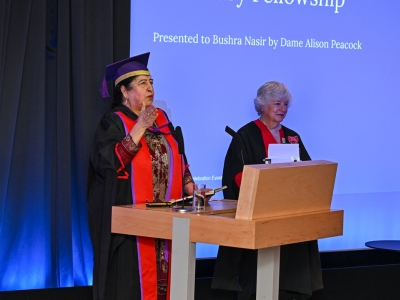
The day was not only an opportunity to reflect on practice, but also to celebrate the achievements of our newest Chartered Teachers and the recognition of colleagues awarded Fellowship status. On receiving her Honorary Fellowship, Bushra Nasir CBE DL FCCT shared a poem that offered a powerful reflection on the teaching profession:
“May your heart always be filled with joy of knowing how deeply you’ve impacted lives. May your days be as inspiring as the lessons you’ve shared, and may the kindness you’ve sown in the minds and hearts of students return to you hundredfold. May your spirit never tire, your wisdom never fade, and your compassion shine brightly. You’re not just a teacher. You are a builder of dreams, a nurturer of potential, and a blessing to every life you’ve touched.”
It was a day that balanced inspiration with celebration, and Chartered College of Teaching President, Aimee Tinkler FCCT, summed it up perfectly:
“It was a real honour to present at the Chartered College of Teaching graduation as President. Professor Cremin’s keynote on reading for pleasure was truly inspiring, and I felt incredibly proud to lead the Council as we celebrated the achievements of our newest Chartered Teachers. Congratulations to all!”
Further Resources
- Reading for Pleasure website
- The OU Reading Schools Programmes: Enriching your Reading Culture – year-long CPD programmes involving the whole school, available for Primary and KS3
- The Reading for Pleasure Quality Mark, led by UKLA and the Open University
- To get in touch with Professor Teresa Cremin CBE directly: teresa.cremin@open.ac.uk