Principles to Practice: Post-Conference Publication
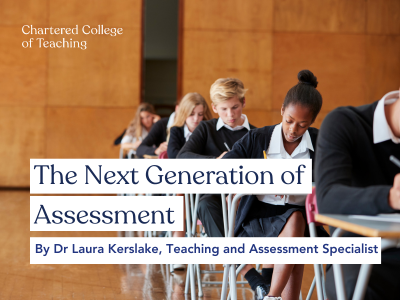
On the 24th February 2026 we held the Next Generation Assessment conference in London. The theme of the day was principles to practice, and we heard several examples of innovative assessment practice being carried out in schools and other organisations, as well as exploring the big ideas in the future of assessment. The post-conference publication includes a summary of the sessions, links to real-world examples of practice as well as links to videos of all of the sessions.
Upcoming webinar
High-quality assessment in primary schools: improving assessment literacy
Date: 11th June 2026
Time: 4:00-5:00pm
Assessment literacy is having the knowledge and skills to design and use effective formative and summative assessments. In this webinar we will explore the principles of good assessment and also the challenges of implementing assessment for different types of learning in primary schools. Robyn Heath will discuss the assessment of project-based learning, Dr Rebecca Clarkson will examine the assessment of writing in KS2, and Stephen Mitchell will explore assessment of and for oracy. We’ll cover themes such as how to support colleagues, building school culture of assessment and designing assessment to help all learners to thrive.
This webinar is aimed at teachers and leaders in primary schools.
Speakers:
- Dr Laura Kerslake, Chartered College of Teaching
- Robyn Heath, Wyborne Primary School
- Dr Rebecca Clarkson, Anglia Ruskin University
- Stephen Mitchell, Kings Cross Academy.
On demand webinar recording
From Principle to Practice: Evidence-Informed Leadership Chapter Deep-Dive (Assessment)
Dig deeper into some of the key principles behind the book, From Principle to Practice: Evidence-Informed Leadership. This first event in a series of chapter deep-dives will explore the following chapter: Purposeful assessment. We talk to the author of this chapter, Corinne Settle, and Claire Badger, who wrote a supporting case study on Building a shared understanding of assessment with parents and students. The discussion covers:
- The importance of building teacher expertise around formative assessment
- The importance of teacher, and leader, assessment literacy e.g. drawing valid inferences from assessments
- How to utilise assessment purposefully
- Cautions around high stakes accountability.
On demand webinar recording
Next Generation Assessment: Making Meaningful Change in Educational Assessment
Meaningful change in educational assessment starts with two things: big ideas about what is needed and the small steps that teachers and leaders can take to bring about this meaningful change. In this webinar, Professor Bill Lucas will be in conversation with Dr Laura Kerslake. They will discuss possibilities for new or alternative forms of assessment that help all learners to thrive. Starting with the big ideas about the next generation of assessment, they will then offer practical suggestions that teachers and leaders can implement in their settings. These will be based on Bill and Laura’s extensive experience in areas such as creative thinking, inquiry learning and oracy, as well as other forms of assessment.
This webinar is suitable for leaders and teachers of learners of all ages. Following the webinar, attendees will receive the publication from the Next Generation Conference (February 2026) which has further links to resources and case studies of assessment practice.
Resources
The DIALLS Project (2018-2021) 
The DIALLS resources are a high-quality example of a research-led approach to developing progression tools for dialogue and cultural literacy. They can be used as part of an approach to teaching and assessing oracy in primary and secondary schools.
DIALLS (Dialogue and Argumentation for cultural Literacy Learning in Schools) was a three year EU-funded research programme led by The University of Cambridge and including 10 universities in and beyond Europe. The project coordinator was Fiona Maine. The project aimed to teach children to ‘be tolerant, empathetic and inclusive through talking together’.
The Chartered College was a key partner in the latter stages of the project. The spirit of DIALLS was to create classrooms where children and teachers could talk together about themes around social responsibility and living together, valuing the responses of each other and celebrating diverse perspectives. The DIALLS wheel captures the heart of this.

These themes for discussion are explored further in the Cultural Learning Progression Tool. There are many books and films with these themes that can prompt discussions!
A key outcome of the project was the Dialogue Progression Tool. This interactive PDF includes a scale of development for dialogue progression – concentrating on the types of behaviours that children are developing as they build their learning community, express their own ideas, relate to the ideas of others and manage multiple perspectives.
Further reading:
Maine, F., Cook, V. and Lähdesmäki, T. (2019). Reconceptualizing cultural literacy as a dialogic practice. London Review of Education, 17(3), 384–393. https://doi.org/10.18546/LRE.17.3.12
Cook, V., Maine, F. & Čermáková, A. (2022). Enacting cultural literacy as a dialogic social practice: the role of provisional language in classroom talk, London Review of Education 20(1) https://doi.org/10.14324/LRE.20.1.02
Maine, F. & Čermáková, A. (2021). Using linguistic ethnography as a tool to analyse dialogic teaching in upper primary classrooms. Learning, Culture and Social Interaction 29, 100500 https://doi.org/10.1016/j.lcsi.2021.100500
Maine F. & McCaughran, B. (2021). Using wordless picturebooks as stimuli for dialogic engagement. In F. Maine & M. Vrikki (Eds.), Dialogue for intercultural understanding: Placing cultural literacy at the heart of learning (pp 59-72). Springer. https://link.springer.com/chapter/10.1007/978-3-030-71778-0_5