
EdTech Evidence Board appointed board announcement

The Chartered College of Teaching is pleased to announce the appointment of seven newly appointed EdTech Evidence Board members who will ratify assessment outcomes for reviews conducted by trained reviewers as part of the EdTech Evidence Board project, funded by the Department for Education. The appointed EdTech Evidence Board members were recruited via an open application process and those who were selected bring vital experience intersecting education, EdTech, evidence evaluation and governance.
The Next Generation of Assessment
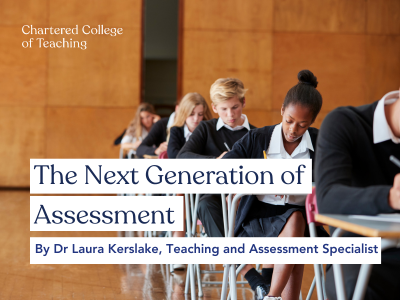
The ‘evolution not revolution’ message of the Curriculum and Assessment Review (DfE, 2025c) (CAR) is such a binary. It is an important message for educational settings who want to change or expand their provision but also need to be mindful of staff workload and wellbeing as well as expertise and capacity.
Exploring the impact of offsite PPA on teacher retention – be part of the research!
Get involved in In phase 2 of our research, where we are continuing to build the evidence base on flexible working!
Next Generation Assessment Project

Funded by the Comino Foundation, the project is led by Dr Laura Kerslake at the Chartered College of Teaching and Professor Bill Lucas from the University of Winchester. In the first phase of the project, we will systematically review the research evidence into different ways of carrying out assessment. We will hold a series of […]
Why the science of learning is a 1000-piece puzzle (with lots of missing pieces)

Dr Lisa-Maria Müller, Head of Research and Policy, Chartered College of Teaching, discussed how at the Global Alliance for the Science of Learning, practitioners championed teacher voices, nuanced evidence use, balanced pedagogy, belonging and diversity to avoid simplistic implementations and unintended consequences.
Teacher Wellbeing Index 2025: an urgent call to Government
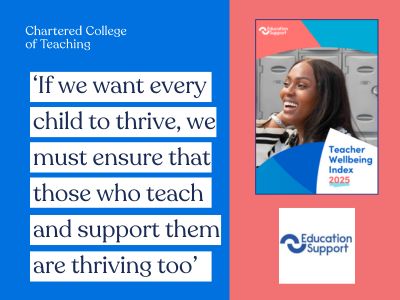
Key findings from Education Support’s ninth annual Teacher Wellbeing Index, offering a detailed insight into the mental health and wellbeing of teachers and education staff across the UK.
Teacher retention: Building the evidence base on flexible working
In collaboration with UCL Institute of Education, we carried out research funded by the Education Endowment Foundation (EEF) to understand more about offsite PPA in primary and secondary schools.
Investing in your teaching practice through the Expertise in Teaching Certificate

As teachers we’re always looking for ways to improve, not by doing more, but by becoming more intentional about what we do in the classroom, so we can make the biggest impact where it matters most. But with so many demands on our time, between the day-to-day challenges of the classroom, to lesson planning, parents’ evenings, last minute lunch duties, and all those other little things we juggle in a day, it can be difficult to pause, reflect and consider how we can make meaningful changes to our practice.
Conversations around education research in my school

Is this research reliable, and is it relevant to our setting? Any teacher, in any school, in any setting can use these two questions as a starting point, no matter where they are in their educational research journey. By prioritising reliability and relevance, and fostering a culture of inquiry, schools can create environments where educational research truly drives improvement.
What next? How to use education research to supercharge your professional development

So, after completing your ECT years, it is normal to think: what next? You may find yourself settling into the rhythm of teaching life and be thankful that the paperwork and self-reflections are now behind you. However, you will feel more invigorated and confident in your career if you maintain a positive trajectory with your professional development.