
In the 80s and 90s, I grew up in a joint family system, my family and the families of my dad’s three other brothers all in a happy, busy home where there was always someone talking, laughing or cooking. In the middle of that constant movement was my mother – a woman who did not have the chance to be educated herself but who understood, more clearly than anyone I knew, what education could make possible.
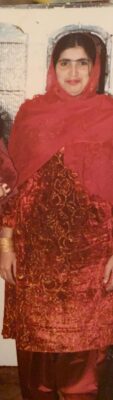 In our quiet moments, she would tell me, quietly but firmly, that she didn’t want me to be dependent on anyone, and she wanted me to know and understand opportunity. She might not have been able to help me revise for exams, but she could make sure I had the time, the space and the expectation to study. Looking back, I realise that her determination was my first lesson in what it means to believe in a girl’s potential, even when the world doesn’t always send that message.
“My mother’s lack of formal education didn’t push me away from school – it pushed me towards it. Teaching became the way I honoured her courage and created my own independence.”
In 2000, I walked into my first classroom as a supply teacher, wanting to know and understand if this space was truly meant for me. I still remember the feel of the register in my hand and thirty faces turning to look at me, weighing up in seconds whether I was someone they could trust. I felt a huge mix of nerves, responsibility and quiet pride. I had made it into the profession my mother had wanted for me – not because it was easy, but because it meant I could stand on my own two feet and, in time, help others do the same. It’s a strange memory, because it was a school that had no diversity and therefore the students were uncertain of where we stood with each other, two of them called out to me ‘Are you here to teach us how to cook curry?’ and ‘We’ll give you three days, you’ll be gone by then’- but I won them over through my passion and my approach learning how to navigate building relationships and allowing them to see that despite our visible differences, there was more to me than ‘making curry’.
In my ‘NQT’ year, I found a place where I belonged. I challenged the students’ stereotypes and allowed them to question respectfully and they helped me understand my role as a teacher. Here, I was struck by the lack of diversity in the teaching community and in leadership even though it was a multicultural school in London. I think subconsciously, it was this point that I decided that at some point, I wanted to venture into leadership in education so that I could represent my community but also as a woman, be seen as a role model by the students.
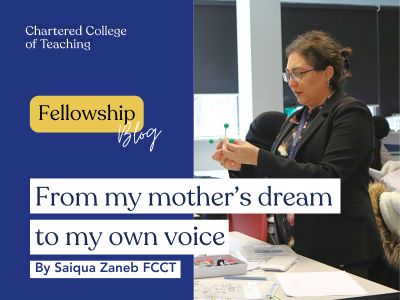
Over the years, I have taught and led in busy, diverse London schools where education really can change the trajectory of a family. I am now an Assistant Headteacher in a large secondary school, with a portfolio that has included initial teacher training, KS3 standards and outcomes, co-curricular and enrichment, behaviour, assessment, data, and staff development. That sounds very technical. But behind every label are real people and real stories.
My journey has not been a straightforward one and in the darkest of my winter journeys home sometimes I found the whispers asking me why I was doing this. But I have loved and do love being part of this rich profession. There are many proud moments to speak of, some to do with student successes and some to do with staff that I have developed…some of my key highlights include:
 Sometimes I think the role of a form tutor is quietly underrated, but it has been one of the great privileges of my career. I adored my tutor group – 7SZB, 8SZB… all the way through to 13SZB. I had the joy of walking alongside them from their first nervous days in Year 7 to the moment they left in Year 13 to follow their dreams. They lifted me up on tired mornings and we carried exam stress, friendship fallouts and teenage worries together. When they left in June and I left that summer to have my first baby, it felt like the end of a very special chapter. What that time taught me is that the simple, daily consistency of a tutor and the psychological safety of that small space can anchor young people; for some who struggled to come into school, knowing SZB was waiting for them was sometimes the reason they did. A dedicated form tutor and a stable, nurturing tutor room can become a daily anchor of safety and belonging that keeps young people connected to school when they need it most.
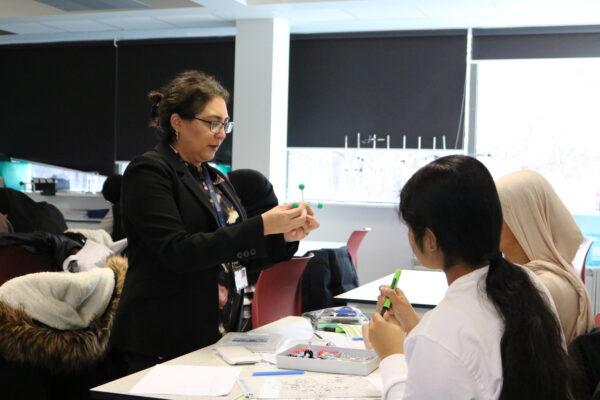
One of the most personal reasons I love teaching is very simple: I love Chemistry. I love it. I love taking an abstract, demanding subject and making it feel possible, even magical, for young people. Years ago, I noticed that one of my usually confident, able students had become withdrawn and quiet in class. Instead of letting it drift, I checked in with her, spoke with our safeguarding lead and made a conscious effort to weave her interests into my lessons so she could see herself in the subject again. She did well in her A levels and, as so often happens in teaching, life moved on and I didn’t think much more about it. Then, years later, an email arrived. She had contacted the school to find me and wrote to say thank you for noticing, for listening, and for helping her see what was possible; she was writing to tell me she had just been awarded a PhD in Chemistry. I was deeply touched – and reminded that what feels like a small act of care to us can change the entire direction of a young person’s life. By truly seeing our students and combining subject passion with quiet pastoral care, we can open doors they never imagined – sometimes all the way to a future they later write back to thank us for.
As a leader, I’ve learned just how hard it is to introduce something new in a school already crowded with worthy priorities, where everyone has a strategic aim and a change they are passionate about. In that context, I designed and implemented a skills-based approach that wove through the curriculum and co-curriculum, helping students to see and develop the transferable skills sitting beneath their subjects and experiences. It forced me to really understand change management – not just the theory, but how to bring people with me, listen, adapt and keep the work grounded in what would genuinely help staff and students. Years later, I can see that change stitched into the tapestry of the school: colleagues talk about how it has shaped their teaching and learning, and former students return from post-18 destinations to say how valuable those skills have been and the doors they helped to open. Change is never easy, but when it is authentic, collaborative and rooted in what really matters, its impact can be genuinely transformational. Thoughtful, collaborative change – rooted in what truly helps teachers and students – may be hard won, but it can quietly reshape a school and open doors for young people long after the initiative began.
Underneath it all is the same belief my mother held: education empowers you, should give you choices, not close them down.
As my roles have evolved, so has my understanding of what leadership really means. It isn’t just about policies, spreadsheets or timetables (although I see plenty of those). It is about how people feel when they walk into a room you are leading. Do they feel heard? Do they feel safe enough to be honest? Do they feel stretched and supported?
Ideas like Radical Candor and psychological safety have shaped my practice – being clear and direct about what needs to improve, while holding deep respect for the person in front of you. I’ve seen, through restructures and challenging conversations as well as celebrations, that the way we treat people in schools matters just as much as the outcomes we chase.
Beyond my own school, my world has widened. I have:
- Served as a Trustee and Advisory Board member, contributing to strategic decisions about culture, curriculum and inclusion.
- Facilitated ECT Mentor programme and mentored ECTs through the East London Teaching School Hub, seeing first-hand the hopes and worries of colleagues at the start of their journey.
- Completed my NPQH and begun a Masters in Educational Leadership and Management, because I believe leaders should keep learning too.
All of this has reaffirmed something I felt as a young teacher but couldn’t yet name: it is not enough for us to work hard within our own classrooms and schools. The systems around us – policy, accountability, funding, public perception – shape what is possible for our pupils and for the profession.
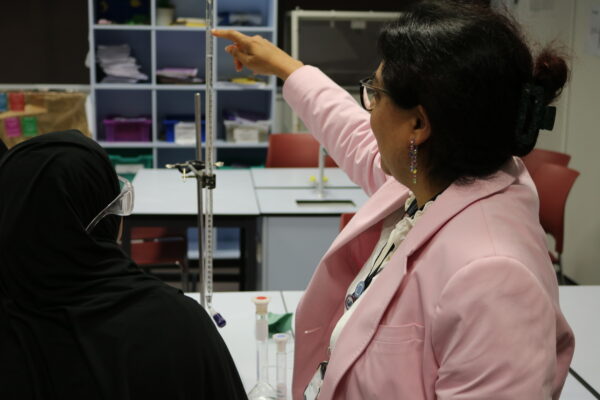 That is where the Chartered College of Teaching came in for me. At first, I joined simply because I wanted a professional home that took teachers seriously. I wanted research that respected the complexity of our work, not quick fixes. I wanted to hear from colleagues across different phases and contexts, not just my own corridor. Through the Chartered College I found language, ideas and a community that helped me make sense of what I was seeing every day.
But over time, something shifted. It didn’t feel right to only receive from this community. I wanted to contribute to it, especially as someone who had come into teaching in 2000 from a background where professional spaces like this weren’t exactly designed with people like my mother in mind.
“There comes a point where you stop asking ‘Who will speak for us?’ and realise the answer might have to be: ‘I will.’”
That realisation is what led me to apply for a fellowship and later be brave enough to stand for Council at the Chartered College of Teaching.
As my career grew – from classroom teacher to Assistant Headteacher, from mentor to NPQ facilitator, from school leader to governor and Advisory Board member – I realised that what I was doing wasn’t just “my job”; it was a sustained commitment to the profession. Applying for Fellowship became a way of naming that.
For me, becoming a Fellow of the Chartered College was not about collecting a title. It was about three things:
- Recognition – not in an ego-driven way, but in an honest acknowledgement that the long evenings, the coaching conversations, the careful curriculum work and the relentless advocacy for students and staff matter, and are part of a bigger professional story.
- Responsibility – a reminder that with experience comes a duty to give back: to mentor others, to share what we have learned, to help shape the culture and direction of our schools and our system.
- Belonging – a sense of standing alongside other teachers and leaders who care deeply about evidence, equity and excellence, and who are trying to do the right thing in difficult times.
Fellowship, for me, has been a way of saying: this is my profession, and I am choosing to stand up for it.
If you are reading this and thinking, “That sounds like other people, not me,” I want to gently challenge that. Fellowship is not reserved for a handful of “perfect” leaders with neat career paths. It is for people who have shown a sustained commitment to teaching, to their students, to their colleagues and to the wider profession – including in the quiet, unseen ways that never make a headline.
You might be:
- The classroom teacher who has quietly mentored generations of colleagues.
- The middle leader who has rebuilt a struggling department with patience and integrity.
- The senior leader who holds the line on inclusion, even when it is hard.
- The educator balancing family life, study and leadership, still turning up every day for the children in front of you.
If any of that feels like you, then you are exactly the kind of person our profession needs as a Fellow.
My mother, who never had the chance to complete her own education, simply wanted me to have choices and independence. Teaching has given me that. Fellowship with the Chartered College of Teaching has given me a way to stand a little taller in that role – not just for myself, but for the communities I serve.
Look at your own journey with honest eyes and notice the impact you have had
If deep down, you know you have given a great deal to this profession, consider applying for Fellowship. Your story and voice deserve to be part of the professional heart of teaching.
Nominate a deserving colleague to become a Fellow in 2026 by Thursday 5th February 2026.
Find out more about Fellowship here or if you have any further questions about Fellowship, please contact us on hello@chartered.college.