
The importance of trust for teacher agency
At a time of eroding trust in the profession, it is important we start talking about trust.
Teacher agency – what it means and why it matters: Launching a new cross-sector working group
Dr Lisa-Maria Müller launches our cross-sector working group to define teacher agency, challenge misconceptions, and show why trusting teachers improves wellbeing, inclusion, retention.
Teacher Agency Working Group
The Chartered College of Teaching’s new working group on Teacher Agency aims to explore what teacher agency really looks like in practice, why it matters, and how it can be meaningfully supported through policy and school leadership. Agency is a core component of professionalism, so it is essential for the sector to understand how teacher […]
Reflections on AI in education

Following a two-day working conference on the topic of artificial intelligence (AI) in Education at the Council of Europe in Strasbourg on the 8th and 9th of October, I wanted to take the time to capture my reflections and open them up for discussion. Written by Lisa-Maria Müller, Head of Research and Policy.
Reflections on ‘Creativity in Education’
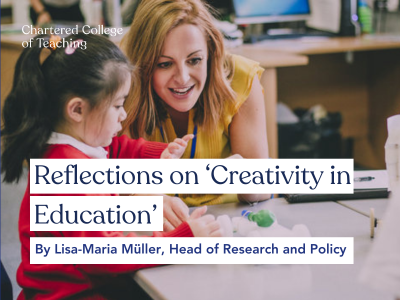
My colleague Jen Crittenden, our Teacher Advocacy Lead, and myself first attended a meeting at OECD Headquarters on Tuesday, 16th of September, to share with colleagues from Canada, China, France, Hungary, India, Slovenia and Portugal our respective progress of adapting the OECD’s professional learning framework on creative and critical thinking to our local contexts. On Wednesday, 17th of September, Jen and I attended the 7th Creativity in Education Summit at UNESCO Headquarters, which brought together policymakers, practitioners and researchers who are interested in fostering creative and critical thinking skills in education.
Changing narratives and flipping scripts
As part of the Chartered College’s series on recruitment and retention, a roundtable with fellows and with colleagues from the Teaching Commission was held with the aim of understanding what teachers feel allows them to have the greatest impact in the classroom. This blog picks out the central ideas from the discussion and positions them in the wider context of national debate about how the education sector can better support teachers to have the impact in classrooms that will give them the meaning and purpose to remain in the job.
Ofsted’s ‘Curriculum’ focus area

Ofsted has sought feedback on its revised inspection framework. In order to inform our response to the consultation, we held a series of roundtables in March, focusing on the areas of inclusion, curriculum and attendance. These roundtables are only part of the work informing our final response and are complemented by an online survey as well as reviews of existing literature and data.
Fellows: SEND roundtable discussion

As the professional body for teachers, we therefore see it as our responsibility to facilitate dialogue between policy and practice in order to ensure that any new policies are both theoretically sound and practically feasible.
What do members want from a new government?

At the Chartered College of Teaching, we believe that education policy should focus on developing and sustaining teacher professionalism.
How an understanding of professionalism underpins our response to Ofsted’s Big Listen

Ofsted inspections need to change. Earlier this year, almost all of more than 2,000 members who responded to our poll agreed, with 83% wanting inspections paused, and 15% suggesting inspection should continue while reforms take place.