
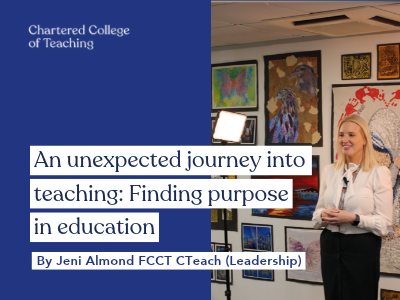
From an unexpected start in the classroom to a career in school leadership, my journey in education has taught me that some of the most rewarding opportunities are those we never planned.
Finding my way into teaching
I never actually wanted to be a teacher!
After completing my degree in Business and Management Studies, I secured a job as a business manager at the secondary school I had attended as a pupil. Returning to those familiar corridors, this time as a member of staff, felt slightly surreal (and it was hard calling my former teachers by their first names!), but I certainly had no plans to enter the teaching profession.
That all changed when my former business studies teacher asked if I would help with a particularly tricky group of pupils. I agreed, not really knowing what to expect, and discovered something that would completely change the direction of my career. I absolutely loved it!
There was something incredibly rewarding about building relationships with those young people, finding different ways to explain things and seeing their confidence grow. Almost overnight, my career plans changed, and I applied to complete my PGCE.
Looking back, I am so grateful for that unexpected opportunity. What started as helping out with a difficult class became the beginning of a career that has taken me in directions I could never have imagined.
A career highlight that changed my perspective
Throughout my career, I’ve been fortunate to experience many different aspects of education, from classroom teaching and middle leadership to senior leadership, headship and, more recently, working across schools at Trust level. However, one experience that will always stay with me is my time as Headteacher of an independent hospital school, supporting young people experiencing significant mental health difficulties.
All of our pupils were receiving inpatient psychiatric care, often at an incredibly difficult and frightening point in their lives. For some, being in hospital was an unfamiliar and unsettling experience, but school offered something different. It was familiar. It provided routine, purpose and a sense of normality at a time when so much else in their lives felt uncertain.
I remember how much some of our young people genuinely looked forward to coming to school. It was somewhere they could be pupils rather than patients, where their identities were not defined by their mental health difficulties and where they could continue to experience success.
Some even completed their GCSE examinations while receiving treatment, achieving qualifications despite the enormous challenges they were facing. Those achievements meant so much more than grades on a piece of paper. They represented resilience, hope and the possibility of a future beyond hospital.
As a member of the wider hospital’s senior management team, I also had the privilege of working alongside clinicians, doctors and other healthcare professionals. This gave me a much deeper understanding of mental health, the complexities of supporting vulnerable people and the importance of working collaboratively across professional boundaries.
That experience fundamentally shaped my understanding of education and leadership. It reinforced my belief that education is about so much more than academic outcomes. At its best, it provides stability, belonging, opportunity and hope.
I’ve also been incredibly fortunate to work with some wonderful colleagues throughout my career. Across the different schools I’ve worked in, I’ve met people who have inspired me, challenged my thinking, supported me through difficult times and, perhaps most importantly, made me laugh along the way! Many of those colleagues have become good friends, and although we’ve since moved on to different schools and roles, those friendships have remained. When I look back on my career, it’s often the people I’ve worked with, rather than the positions I’ve held, that I remember most fondly.
Looking ahead: The importance of ethical leadership
Today, I work as a Regional Improvement Officer, supporting secondary schools and their leaders to improve educational provision and outcomes for young people. It’s a role that draws on my experience across different educational settings and gives me the opportunity to work alongside leaders facing a wide range of challenges.
Alongside my professional role, I’m also a governor at both a primary and a secondary school. I’ve really valued the opportunity to experience education from a different perspective, particularly the responsibility that governors have in supporting and challenging school leaders. It has given me a greater appreciation of the importance of effective governance and the contribution that governors can make to school improvement. It’s also another opportunity to continue learning, which is something I’ve always enjoyed about working in education.
Throughout my career, I have been particularly drawn to working in schools serving communities facing significant challenges. This has been a conscious choice, driven by my belief that every young person deserves an excellent education, regardless of their background or circumstances. I would never claim to have always made the difference I hoped to make, and there have certainly been challenges and setbacks along the way. However, these experiences have taught me a great deal about the complexities of school improvement and the responsibility we have as leaders to keep learning and striving to do better.
As I look to the future, I am particularly passionate about ethical leadership and the responsibility we have to support those leading our schools. School leadership is enormously rewarding, but it can also be challenging and complex. Improving outcomes for young people, maintaining high expectations and holding ourselves and others to account are fundamental responsibilities. However, I believe that how we approach these responsibilities matters enormously. I’ve learnt that you can have the best improvement plans in the world, but if you haven’t built trust with the people you’re working alongside, achieving meaningful change becomes much harder.
I’ve also come to realise that being a supportive leader doesn’t mean avoiding difficult conversations or lowering expectations. Sometimes, the most important thing we can do is challenge, but I believe we should always be mindful of how that challenge is delivered.
I also recognise that I am very much a work in progress myself. Despite the experience I have gained, I can still be incredibly self-critical, question my own decisions and sometimes find it difficult to switch off from the challenges of leadership. I care deeply about doing a good job, but I am learning that this can sometimes come at the expense of my own wellbeing. I don’t always get the balance right, and I certainly don’t have all the answers.
Perhaps that is why I feel so strongly about the importance of compassionate, ethical leadership. We need professional cultures where leaders feel able to acknowledge their vulnerabilities, seek support and continue learning, without feeling that doing so somehow diminishes their credibility.
Looking ahead, I hope to continue supporting school leaders to develop their confidence, strengthen their practice and lead improvement in ways that are both ambitious and sustainable. I am also keen to develop my coaching expertise through a formal qualification, recognising the powerful role that coaching can play in helping leaders reflect, grow and find their own solutions.
Why professional community matters
One of the reasons I value being part of the Chartered College of Teaching is its commitment to recognising teaching as a profession grounded in expertise, evidence and professional judgement.
Throughout my career, I have come to appreciate just how important it is for teachers and leaders to have opportunities to engage with research, reflect on their practice and learn from one another.
Achieving Chartered Teacher (Leadership) Status was an important milestone in my own professional development. It provided an opportunity to reflect critically on my leadership practice, engage with evidence and consider how I could continue to improve. If anything, the experience reminded me just how much I still have to learn. I think it’s easy to assume that once you’ve reached a certain stage in your career, you should have most things figured out. I certainly haven’t!
Education can sometimes feel like a profession in which change is happening to us rather than with us. I believe we need a strong, independent professional body that champions the teachers’ expertise and ensures their voices are heard in conversations about the future of education.
For me, becoming a Fellow of the Chartered College is a recognition I value enormously, but I also see it as a responsibility: to contribute to the profession, share what I have learned, support others and continue challenging my own thinking.
I would encourage colleagues at every stage of their careers to consider joining the Chartered College and, where eligible, applying for Fellowship. You don’t need to have followed a particular career path or have all the answers to make a valuable contribution. We all have different experiences, and there is enormous value in sharing not only our successes, but also the challenges we have faced and lessons we’ve learnt along the way.
When I think back to that young business manager who agreed to help with a challenging class, I could never have imagined the journey that would follow. Perhaps that is what makes education such a special profession; you never quite know whose life you might change, what you might learn along the way, or where an unexpected opportunity might lead. And for me, that is what makes it all worthwhile.